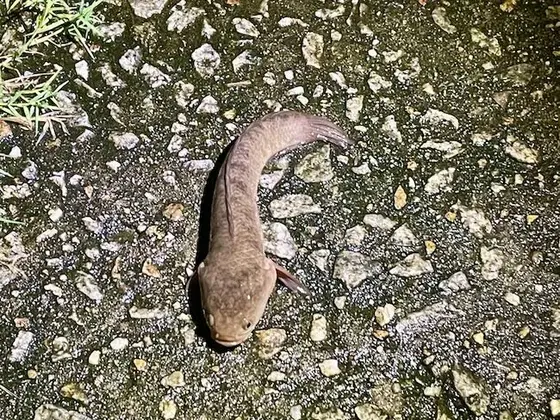
Last night I came across a fish on the footpath near my house. Over the
past year living here, I’ve run into (and tried not to step on) countless
snails, toads, and lizards. People have warned me about snakes, but I
haven’t seen one yet. And I have never expected to encounter a
fish — fish inhabit bodies of water, and paths are not part of
those. And yet, there it was: a fish, lying in the middle of the path.
A fish lying on the path
I decided to move the fish from the path into the puddle. First, I figured
it might suffocate without water. Second, one of the stray dogs — the ones
the neighbours feed — might eat it. Third, it could get run over by
a motorcycle. In short, I was concerned for the fish’s life.
I picked two leaves off a bush to use like napkins, and lifted the fish off
the ground. The fish suddenly slipped out of my hands, flopped back down,
and wriggled into the puddle — exactly where I’d meant to put
it. So, nothing worked, and everything worked.
* * *
Most likely, it was a snakehead (Channa). Snakeheads live in still water,
can breathe air, and are capable of moving between ponds over land. It’s
been raining
heavily
since last night here in Hong Kong — which probably explains how the fish
ended up in our little frog pond. Saving a snakehead from suffocating was
an act of ignorance — but saving it from a dog or a motorcycle
made perfect sense.
Fragment from the
official broadcast. Video used for non-commercial purposes to illustrate the discussion.
Perhaps it was the imperfections in the league rules that caused
FC Chelyabinsk to choose to lose rather than attempt to equalise.
FC Chelybinsk won the spring part of the season and enter the final week at
third, two points ahead of Mashuk-KMV, Volgar and Leningradets. A
five-point advantage over Veles secured the team a place in the promotion
play-offs.
Standings before the final matchday
Team
GP
W
D
L
GF
GA
Pts
3
FC Chelyabinsk
17
8
2
7
17
20
26
4
Mashuk-KMV Pyatigorsk
17
5
9
3
19
12
24
5
Volgar Astrakhan
17
6
6
5
16
17
24
6
Leningradets Len. Obl.
17
6
6
5
19
20
24
7
Veles Moscow
17
6
3
8
20
21
21
How does the second league work?
Second league is the third and forth (after the Premier and First
leagues) tiers of the football pyramid in Russia. It has a rather
whimsical format.
From the 2023-2024 season onwards, the second league has been split into
two divisions. Division B is divided in 4 groups, largely on a geographic
basis. Teams play a double round-robin tournament from spring to autumn.
The group winners are promoted to the ‘Silver’ group of the Division A.
Division A comprises 20 teams, which are divided into the ‘Gold’ and
‘Silver’ groups. Teams play from autumn to spring. The season is split
into separate autumn and spring parts. Both parts are double round-robin
competitions.
After the autumn part of the season, the top four Silver teams are
promoted to Gold. The bottom two teams are relegated to Division B, while
the teams in seventh and eighth place play relegation play-offs against
the bottom two teams from the spring part of the competition. The losers
of these play-offs are also relegated to Division B.
If a team that finished in the bottom two in the spring part of the
competition finishes in 7th or 8th place, they are relegated without
play-offs. If a team that finished in the bottom two in the spring part
earns promotion in the autumn, they do not play in the play-offs but are
promoted to Gold instead. Instead, the team in eighth place at the end of
the autumn part is eliminated without play-offs. If both teams in the
bottom two earn promotion, then the bottom four teams in the autumn part
are eliminated without play-offs.
The bottom four Gold teams are relegated to Silver. The group winner
earns the right to play in the promotion play-offs.
After the spring part of the season, no Silver team is relegated; the
bottom two play relegation play-offs after the autumn part (see
above). The top four teams are promoted to Gold. The bottom four Gold
teams are relegated to Silver.
The top two Gold teams are promoted to the First League. The third team
plays the autumn winner in a promotion play-off. If the autumn winner
secures a place in the top three, then the top three teams are promoted
automatically. If the autumn winner finishes in the bottom four in the
spring part, they are relegated to Silver. The runners-up or the third
place teams take their place in the promotion play-offs (but only if they
did not finish in the top two or bottom four in the spring). If the top
three teams remain the same after the autumn and spring parts or if all
autumn top-three teams are relegated, then the spring top three promotes
to the First League.
After conceding a goal in the 79th minute, FC Chelyabinsk had a number of
scoring chances, but completely gave up on progressing their possession
in injury time. They passively passed the ball in their own half.
If Chelyabinsk equalised, they would earn 27 points, which would put them
in level with Volgar and Leningradets, provided they won their
respective matches against Rodina-2 Moscow and Spartak Kostroma. If so,
Leningradets would finish third based on the tie-breaking rules.
FC Chelyabinsk, Volgar, and Leningradets face-to face
03/09 FC Chelyabinsk v Leningradets 1-2 03/23 Volgar v Leningradets 1-0 04/19 Volgar v FC Chelyabinsk 0-0 04/27 Leningradets v FC Chelyabinsk 1-0 05/11 Leningardets v Volgar 1-1 06/01 FC Chelyabinsk v Volgar 2-0
Hypothetical standings (FC Chelyabinsk, Volgar, and Leningradets tie)
Team
GP
W
D
L
Pts
3
Leningradets
4
2
1
1
7
4
Volgar
4
1
2
1
5
5
FC Chelyabinsk
4
1
1
2
4
If Mashuk-KMV won, they would be level with Volgar and Leningradets on 27
points. According to the tie-breaking rules, Mashuk-KMV would then finish
third.
Mashuk-KMV, Volgar, and Leningradets face-to-face
03/16 Mashuk-KMV v Volgar 1-2 03/23 Volgar v Leningradets 1-0 04/06 Mashuk-KMV v Leningradets 0-0 05/11 Leningradets v Volgar 1-1 05/04 Volgar v Mashuk-KMV 1-2 05/24 Leningradets v Mashuk-KMV 1-4
Before the match journalist Sergey Ilyev
reported that Mashuk-KMV had not obtained a
licence to play in the First League. According to the regulations, only
licensed teams can participate in the promotion play-offs.
The regulations do not clarify whether a play-off team will be replaced if
it fails to obtain the licence. It is plausible to suggest that FC
Chelyabinsk gave up playing after receiving a hint from the dugout to allow
Mashuk-KMV to secure the third place and earn promotion without play-offs.
Mashuk-KMV won the match. Leningradets and Volgar also won their respective
matches, and the final standings are as follows:
Team
GP
W
D
D
GA
GF
Pts
3
Mashuk-KMV Pyatigorsk
18
6
9
3
21
13
27
4
Volgar Astrakhan
18
7
6
5
18
18
27
5
Leningradets Len. Obl.
18
7
6
5
20
20
27
6
FC Chelyabinsk
18
8
2
8
18
22
26
The regulation states that the fourth team can replace one that refuses
promotion. Perhaps Volgar will refer to this clause to justify their right
to participate in the promotion playoff. So far, Football National League
has reported that it is awaiting confirmation
of licences for FC Chelyabinsk and Mashuk-KMV from the Russian Football
Union.
FC Volga Ulyanovsk secured second place in the Division A. Next season,
they will play in the First League for the third time in their history.
Forward Dmitriy Kamenshchikov was the season’s top scorer with 16 goals.
I came across a curious inaccuracy in Eric Dunning’s texts on the origins
of the sociology of sport. Dunning repeatedly refers to Heinz Risse, the
author of what appears to be the first monograph to feature the phrase
‘sociology of sport’ in the title (Sociologie des Sports, 1921), as
a student of Theodor Adorno.
Adorno supervised the work on sport of Heinz Risse whose Soziologie
des Sports (1921) was, so far as I know, the first time that this
subdiscipline was explicitly named. Adorno also supervised the work
of Bero Rigauer which resulted in Sport und Arbeit (Sport and
Work) (1969).1
To my knowledge, the sociology of sport first emerged as a specific,
named endeavour and the subject of a book-length study in 1921 when
Heinz Risse, a student of Theodor Adorno, published his
Soziologie des Sports.2
Adorno was five years younger than Risse and had only just entered the
university in 1921. Risse’s supervisor in the early 1920s was Alfred
Weber.
Dunning and Coakley co-edited the collection Handbook of Sports Studies
(2000). There, Risse is also referred to as Adorno’s student (p. xxii),
although the collection features Klaus Heinemann’s piece on the development
of the sociology in Germany, which mentions (p. 536) Risse (without
biographic details).
Thence, always double-check. Even the classics.
Eric Dunning, Sport Matters, Sociological Studies of Sport,
Violence and Civilization. (London: Routledge, 1999), 256. ↩︎
Eric Dunning, “Sociology of Sport in the Balance: Critical
Reflections on Some Recent and More Enduring Trends,” Sport in Society 7,
no. 1 (2004): 4. ↩︎